The goal
These studies applied signal-processing theory to two complete MATLAB workflows. The main project transmitted and recovered a digital text message while comparing pulse shapes, sampling rates, bit rates, and noise levels. A supporting team project built a six-band RC equalizer and used frequency-domain plots to inspect how its filters reshaped audio.
SYSTEM ARCHITECTURE
Binary PAM chain
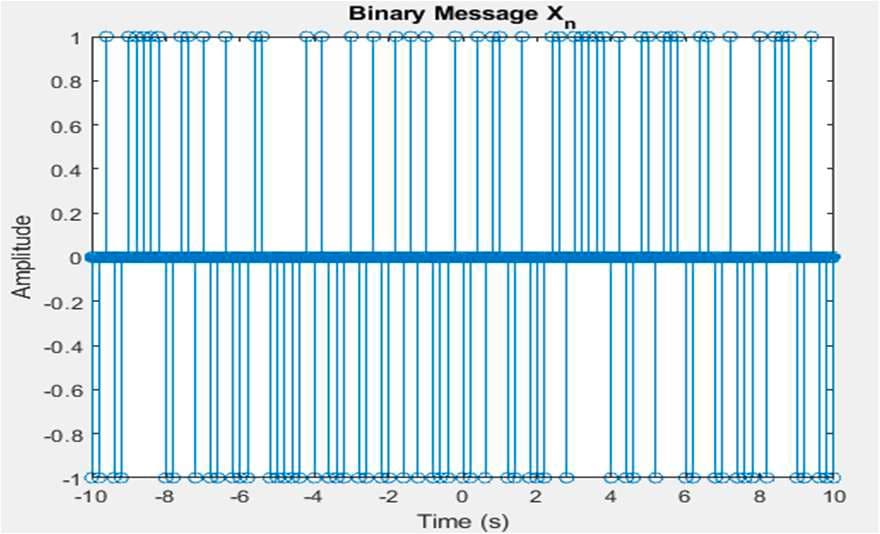
text → symbols → pulse shaping → modulation → noisy channel → matched filter → recovered bitsText was converted to binary symbols and shaped with either a triangular or sinc pulse. After modulation and simulated channel noise, the receiver downconverted the signal, applied a matched filter, and sampled each symbol to reconstruct the message.
Six-band RC equalizer
audio → six RC frequency bands → adjustable gains → reconstructed outputLow-pass, band-pass, and high-pass RC sections divided the audio spectrum into six bands. Adjustable gains created bass, treble, and near-unity responses, while Bode plots and spectrograms showed how each setting changed the signal.
Parameter experiments
change pulse, rate, sampling, and noise → compare recovered bitsThe working link was stressed by changing one parameter at a time. Comparing the decoded message against the transmitted bits made the effects of bandwidth, sampling, and channel noise visible in the error rate.
Development
- STAGE 01
Build the audio filter bank
Built an end-to-end binary PAM simulation that converted text into symbols, shaped and modulated the signal, added noise, and recovered the transmitted bits.
- STAGE 02
Inspect and reshape the spectrum
Implemented a matched-filter receiver and compared triangular and sinc pulses using the same message and channel structure.
- STAGE 03
Transmit with two pulse shapes
Varied bit rate, sampling rate, and noise strength to identify when the baseline link began producing errors.
- STAGE 04
Recover the message with matched filtering
Designed a six-band RC equalizer and used frequency-response plots and spectrograms to evaluate its effect on audio.
The hardest parts
Pulse shape is a bandwidth choice, not a free upgrade
The triangular pulse was compact in time but occupied more bandwidth, while the sinc was narrower in frequency and extended across more symbols. Both worked at the baseline setting; their practical differences appeared when the bit rate and noise were increased.
A working receiver depends on the full signal chain
Increasing the bit rate reduced separation between symbols, insufficient sampling lost waveform information, and stronger noise obscured the matched-filter decisions. Testing these changes end to end showed that receiver performance could not be explained by any one setting alone.
Simulation results need the right scope
The experiments reveal useful trends, but they are individual MATLAB runs with ideal synchronization rather than a statistical communication benchmark. The team equalizer remains a supporting signal-processing study, while the PAM link is the primary individual implementation.
Results
- At the baseline 5 bit/s setting, both pulse shapes recovered the transmitted English message without bit errors.
- Raising the bit rate to 20 bit/s produced 24.8 percent errors with the triangular pulse and 19.5 percent with the sinc pulse.
- Stronger noise increased errors for both signals, with the sinc retaining a lower documented error rate at the moderate-noise setting.
- Bode plots, impulse responses, spectrograms, and output spectra document the behavior of the six-band equalizer.
What I learned
Communication performance emerged from the complete chain: pulse shape, sampling, bit rate, noise, and receiver design all affected the recovered message.
The pulse comparison showed a real engineering tradeoff between time localization and bandwidth rather than one universally better waveform.
Recovering a message once verified the implementation; stressing the link revealed where and how it began to fail.
Technical archive
Binary PAM case study
Individual binary-PAM report covering triangular and sinc pulse shaping, 20/30 Hz mixing, matched-filter detection, and the bit-rate, sampling, and noise sweeps.
Audio equalizer case study
Team report on the six-band RC equalizer, bass/treble/unity presets, and spectrogram-guided noise reduction.