What I compared
I used one short-period aircraft pitch model to compare six control methods: robust-servo LQR, H∞, projective control, LQG/LTR, OBLTR, and adaptive OBLTR. The value of the project is the analytical comparison—state-space derivations followed by step responses, Nyquist and Bode plots, singular-value margins, sensitivity, noise response, and actuator demand under consistent assumptions.
SYSTEM ARCHITECTURE
Establish the plant and robustness baseline
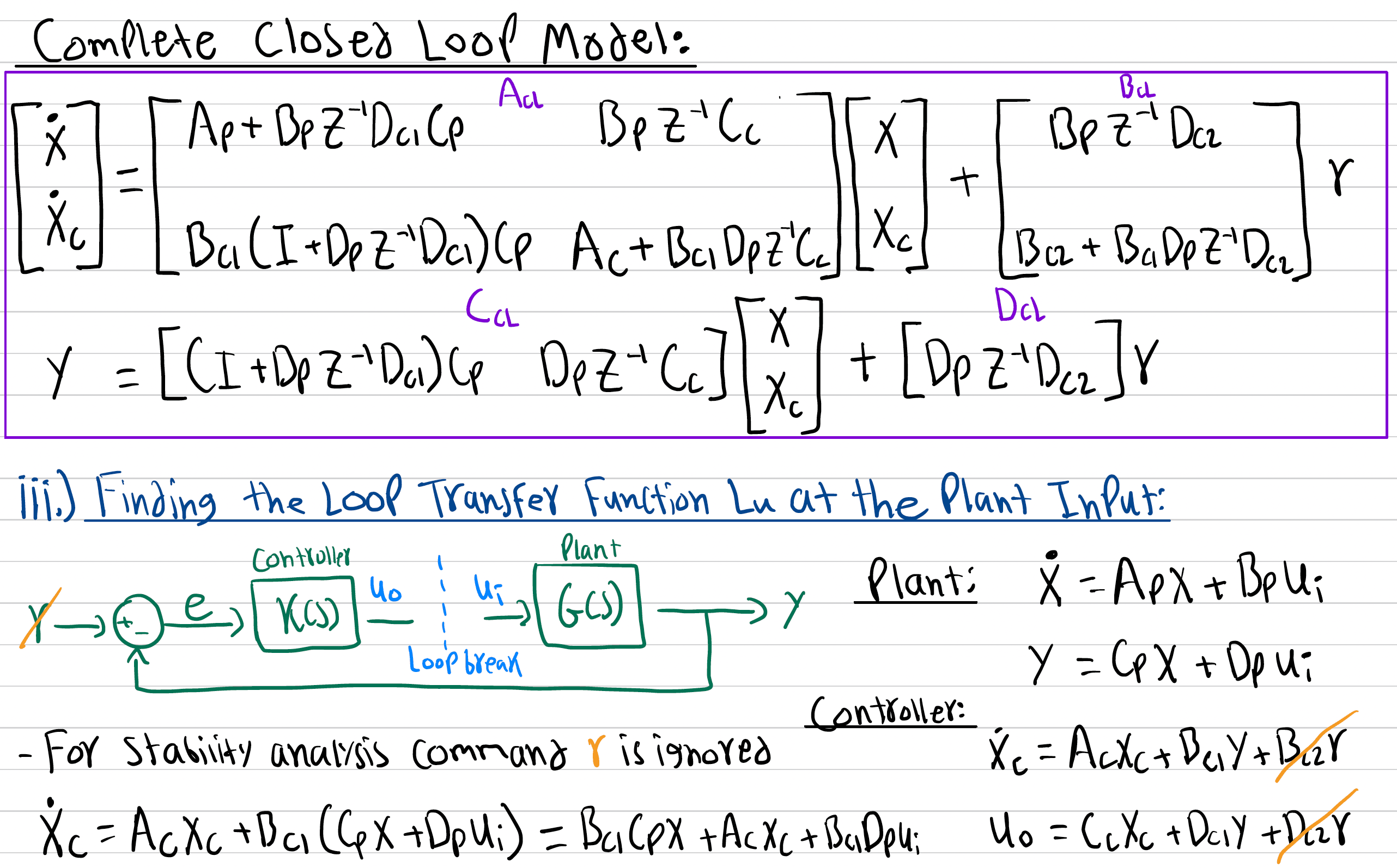
short-period dynamics + elevon actuator → Az and q loopsThe main case study derives the closed-loop and loop-break models, then evaluates response, classical margins, singular values, sensitivity, and the effect of actuator bandwidth.
Select a robust full-state design
200 RSLQR candidates → response and margin charts → 11.5 Hz designA parameter sweep made the trade between speed, undershoot, control effort, and robustness visible before selecting a controller.
Compare controller families
RSLQR ↔ H∞ ↔ projective control ↔ LQG/LTR ↔ OBLTREach method was evaluated on the same pitch plant using comparable time- and frequency-domain plots rather than isolated demonstrations.
Add adaptation
pitch-plant uncertainty → adaptive OBLTR → updated controlAdaptive OBLTR extended the comparison to prescribed uncertainty cases. A separate scalar MRAC roll study remains supporting material and is not counted among the six pitch-control methods.
How I evaluated the designs
- STAGE 01
Analyze the aircraft pitch loop
Derived the aircraft and actuator state-space models, opened the loops at the plant input and outputs, and established the common robustness measures.
- STAGE 02
Choose the robust baseline
Swept 200 robust-servo LQR designs and selected an 11.5 Hz bandwidth from response, undershoot, elevon-rate, and margin charts.
- STAGE 03
Compare controller families
Designed H∞, projective, LQG/LTR, and OBLTR controllers and compared them with the RSLQR using the same response and loop-analysis views.
- STAGE 04
Introduce adaptation
Evaluated adaptive OBLTR under prescribed pitch-plant uncertainty and used a separate scalar MRAC study to examine tracking and gain adaptation.
Key engineering decisions
Keeping the comparison fair
Controller rankings are only useful when the plant, acceleration command, actuator, loop break, and evaluation measures stay consistent. Holding those assumptions fixed made the plots directly comparable.
Choosing an engineering compromise
More bandwidth improved speed but increased undershoot and elevon demand. Likewise, the H∞ mathematical optimum produced impractical gain, so the selected designs balanced response, margins, noise, and control effort.
Recovering performance from measured outputs
Full-state feedback provided the strongest reference, but practical designs rely on measured outputs. The LQG/LTR, OBLTR, and projective studies show how closely that loop behavior could be recovered and what was lost in the process.
What the analysis showed
- The 47-page aircraft-pitch case study documents the plant and actuator derivations, loop models, step responses, classical margins, singular values, sensitivity, and loss of stability as actuator bandwidth falls.
- The 200-design RSLQR sweep led to an 11.5 Hz selection with zero command overshoot, 20.7% undershoot, and a 63.8° classical phase margin.
- H∞, projective control, LQG/LTR, and OBLTR were compared against that baseline through response, Nyquist, Bode, return-difference, and noise-to-control plots.
- Adaptive OBLTR and the supporting MRAC study add uncertainty, tracking, and gain-history evidence while remaining simulation results.
What I took from it
Controller comparisons only became meaningful after I held the plant, command, actuator, loop definition, and evaluation measures constant.
A mathematical optimum is only a starting point. The useful design also had to balance response speed, robustness margins, measurement noise, and actuator demand.
Reports and analysis
Aircraft pitch robustness case study
47-page derivation and MATLAB analysis covering the pitch plant, loop breaks, response and robustness measures, actuator dynamics, and bandwidth sensitivity.
Frequency-domain analysis
Classical and singular-value margins for a supplied SIMO pitch loop, including Nyquist, Bode, return difference, and stability robustness.
Robust-servo LQR
200-point design-chart study and the selected 11.5 Hz Az-command controller, with loop-at-input analysis on the 11 Hz actuator model.
H∞ state feedback
Weighting-filter setup, γ iteration from an H∞-optimal value near 1.073, and rise-time matching to the RSLQR.
Projective control comparison
Five-state RSLQR, static projective control, H∞, and the original RSLQR compared on step response, margins, and noise-to-control maps.
LQG/LTR output feedback
Doyle–Stein observers at three recovery parameters, analyzed with the actuator in the plant and out of the observer design.
Lyapunov analysis and OBLTR
Quadratic Lyapunov arguments for selected systems, then observer-based loop-transfer recovery of the RSLQR with a −10 transmission zero.
Scalar MRAC roll dynamics
Debugged supplied model-reference adaptive control for first-order roll dynamics, with step, sine, and ramp tracking and gain histories.
Adaptive OBLTR cases
Supplied adaptive-OBLTR script run with actuators on across LQR, OBLTR, adaptation, and two subtracted-uncertainty configurations.