The studies
This page connects three MATLAB studies of nonlinear systems. The first learned local Van der Pol motion from sampled transitions. The second used Frobenius–Perron, Koopman, and clustering views to reveal structure in the same oscillator. The third repeatedly linearized, steered, and rolled out nonlinear trajectories on a nonholonomic integrator and a controlled Van der Pol system.
SYSTEM ARCHITECTURE
Learn local motion
1,000 sampled transitions → Delaunay mesh → local affine maps → rolloutEach triangle approximated one step of the Van der Pol flow. Repeated local predictions were then compared with direct ode45 integration.
Expose nonlinear structure
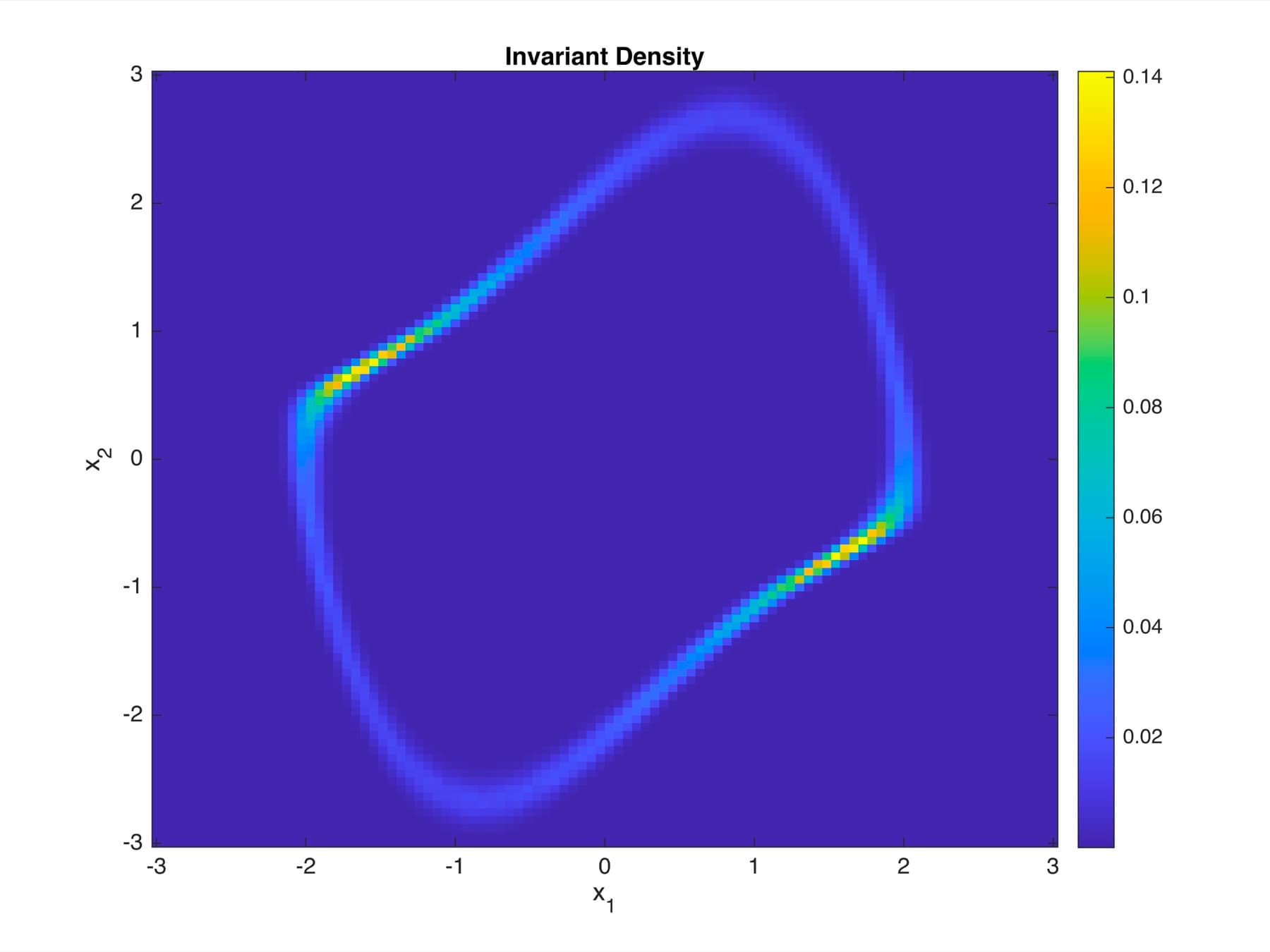
snapshot data → density transport + EDMD observables + clustered local flowOperator and clustering methods showed where trajectories concentrate, which lifted quantities may remain structured, and where the local flow behaves similarly.
Steer the nonlinear plant
nominal trajectory → local linearization → steering update → nonlinear rollout → repeatThe iterative controller first satisfied the endpoint task and then reduced input energy, checking every local update against the nonlinear dynamics.
What I implemented
- STAGE 01
Build the sampled flow map
Sampled 1,000 Van der Pol states, advanced each by 0.1 seconds with ode45, and triangulated the paired snapshots into a piecewise-affine flow map.
- STAGE 02
Test multi-step prediction
Iterated the learned map as a multi-step predictor and compared its trajectory with direct integration from the same initial condition.
- STAGE 03
Analyze the nonlinear structure
Estimated density transport with a Monte Carlo Frobenius–Perron matrix, applied EDMD with nine polynomial observables, and clustered related local flow maps.
- STAGE 04
Iterate nonlinear steering
Implemented a 200-step linearize–steer–rollout loop on a nonholonomic integrator, then applied the same structure to controlled Van der Pol dynamics.
Interpretation and scope
The learned map remained local
Prediction quality depended on sample density, triangle geometry, and staying inside the sampled region. A close overlay on one trajectory verified the implementation but did not establish accuracy across the full state space.
Numerical modes were candidates, not proofs
The dominant density mode and eigenvalue-one EDMD observable depended on the grid, sample count, and chosen polynomial dictionary. They reveal computational structure but still require analytical verification before being called exact invariants.
Every steering update needed nonlinear validation
A successful linearized update could still miss when applied to the nonlinear plant. Rolling out both trajectories at every iteration exposed that gap and kept endpoint steering separate from later energy reduction.
What worked
- The triangulation predictor remained visually close to ode45 on the documented multi-step trajectory toward the Van der Pol limit cycle.
- Frobenius–Perron evolution moved a uniform density toward the oscillator's limit cycle, while the clustering curve showed diminishing improvement beyond roughly eight groups.
- Nonholonomic and Van der Pol animations compare the nominal, linearized, and nonlinear trajectories across successive steering updates.
- Input-energy plots decreased after the endpoint task was satisfied in the demonstrated iterative-control runs.
Takeaway
A learned dynamics model is only trustworthy inside the region supported by its data, so multi-step rollout against the known plant mattered more than a clean one-step fit.
Local linearization was useful for proposing control updates, but the nonlinear rollout remained the deciding test for whether each update actually improved the trajectory.
Study reports
Van der Pol triangulation predictor
Flow-prediction study using snapshot sampling, Delaunay maps, N-step prediction versus ode45, and configuration-space collision geometry.
Koopman and Frobenius–Perron analysis
Operator-analysis study covering Monte Carlo density transport, an EDMD conserved-observable candidate, and local-flow clustering.
Iterative nonlinear optimal control
Iterative-control study covering nonholonomic endpoint steering, energy reduction, and controlled Van der Pol stabilization.